
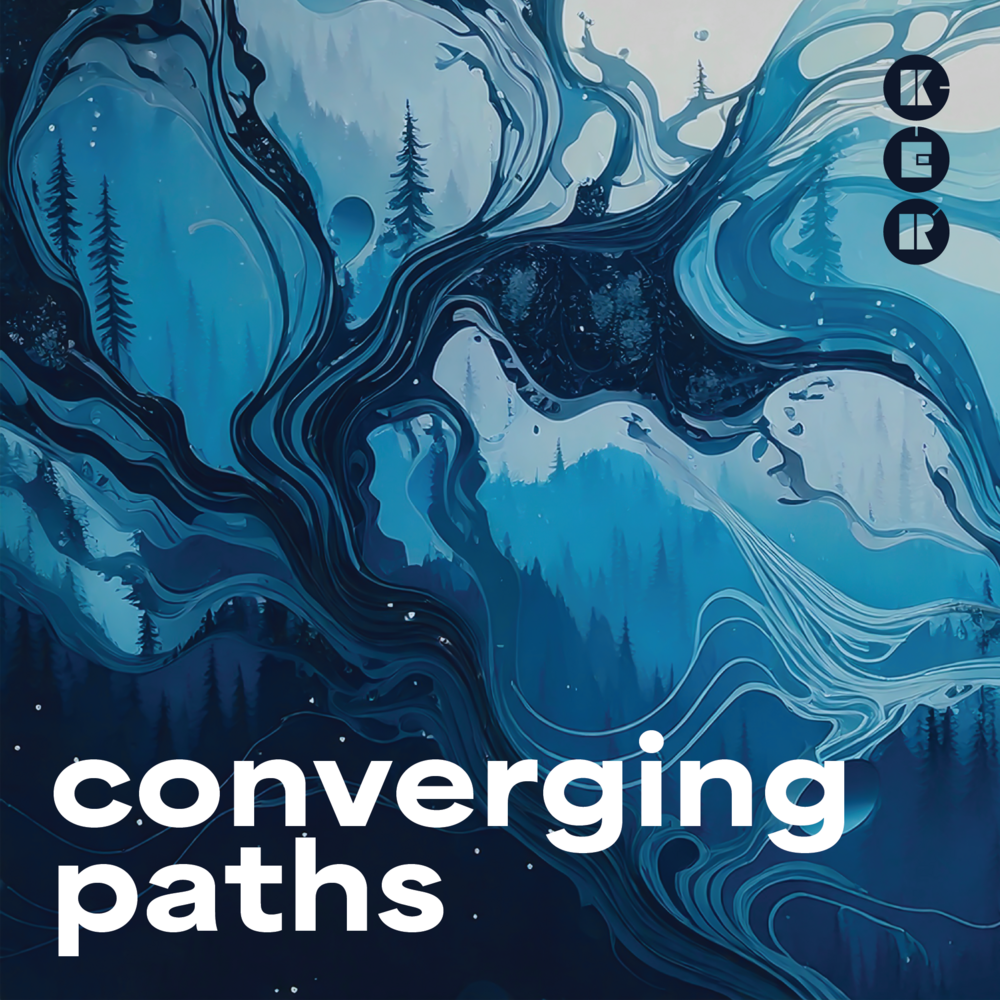
If recent days have been spent watching low cloud drift across the Highlands, or tracing rain as it slides slowly down a windowpane, Wondering on Giants comes as a natural companion. Released recently, the track offers a measured but confident introduction to Ker — the musical identity of Scottish producer and singer-songwriter Barry G.K. Thomson. It arrives without fanfare, grounded in atmosphere, melody, and a sense of perspective that doesn’t fade quickly.
A timeless, three-cornered relationship between humanity, rugged peaks, and the shifting elements is what drives the song. Acoustic guitar, sympathetic keys, and an unhurried rhythm give the track room to breathe, while its imagery — veiled hillsides, high ridges, and circling birds — establishes a strong sense of place. The effect is large in scale, yet close to home. Its reception has prompted curiosity not only about the song itself, but about the broader body of work it introduces.
That work is Converging Paths, a thirteen-track debut album scheduled for release in 2026. While Wondering on Giants focuses on physical scale and natural presence, Ker has hinted that the album gradually turns inward. The project is shaped around shared experience and individual reflection, with the intention of leaving listeners uplifted, steadied, and quietly energized.
The coming months will begin to reveal more of that emotional terrain. Toward the end of January, two new tracks, There Are No Words and Lofty Thoughts, will be released. Details are being kept intentionally minimal, but the songs are described as addressing familiar, often unspoken ideas — our tendency to hold on to memories and objects long after their purpose has passed, and the way certain melodies arrive uninvited, yet stay with us. The outward focus of mountains and weather will soon be joined by inner spaces shaped by memory, affection, and quiet recognition.
Much of the album has taken shape in Ker’s garden studio, where the sound has been developed through collaboration. He handles the songwriting, lead vocals, and guitar work, while Pete Fairbairn contributes piano, Hammond organ, Rhodes, and bass. Jamie Graham, who also serves as producer and sound engineer, anchors the recordings on drums. Together, they’ve created a sound that remains open and organic, without crowding the songs or losing sight of their emotional center.
Ker’s path to this point has been anything but typical. After spending most of his professional life in marketing rather than music, he returned to songwriting later on, first taking up the guitar in 2014 and gradually expanding his musical language to include piano and formal notation. Influenced by the progressive rock bands of the late 1960s and early 1970s — particularly Yes and Pink Floyd — he brings an appreciation for structure, atmosphere, and patience to his work. At the same time, there’s a clear commitment to straightforward songwriting, shaped by a long-standing fascination with lyrics that connect without overstating their case.
The release schedule for Converging Paths reflects this considered approach. Following January’s tracks, Big Boots is expected in mid-March, with Just What Happened and Snowbirds arriving in late April. Additional releases will follow through late spring and early summer, building steadily toward the album’s full unveiling. Each song is intended to stand on its own, while contributing to a wider set of observations on life — personal in origin, but deliberately broad in reach.
For listeners drawn to music that offers space rather than spectacle, this debut is shaping up to be a welcome presence. At moments when Ker sings about the pull of the natural world or the quiet gratitude found in shared experience, the songs come across as reflective without being inward-looking. They suggest common ground rather than conclusions.
At a moment when songs are often rushed, there’s something quietly assured about this slow, deliberate release pattern. Ker is more interested in building a body of work that holds together over time than in chasing immediacy. By working closely with a piano teacher to deepen his understanding of musical theory, he’s reinforcing the craft beneath the songs, ensuring they stand up to repeated listening.
As the year turns and new material begins to surface, Converging Paths is just the opening chapter. In the soft light of a Scottish afternoon, as mist lifts and shadows stretch across the hills, these songs take their time — moving at a pace that allows the paths we walk, the memories we keep, and the music we carry to fall naturally into place.